If marketing feels random in your business, it probably is.
You post when you have time.
You tweak your website.
Mostly never, if we're being honest.
You boost something because someone said it works.
And then you wonder why nothing sticks.
You probably don't hate marketing. You hate guessing.
The problem usually isn't effort. It's that you don't understand the customer journey before they buy.
Do you prefer to learn by listening?
What a marketing funnel actually is (and why it matters for small business)
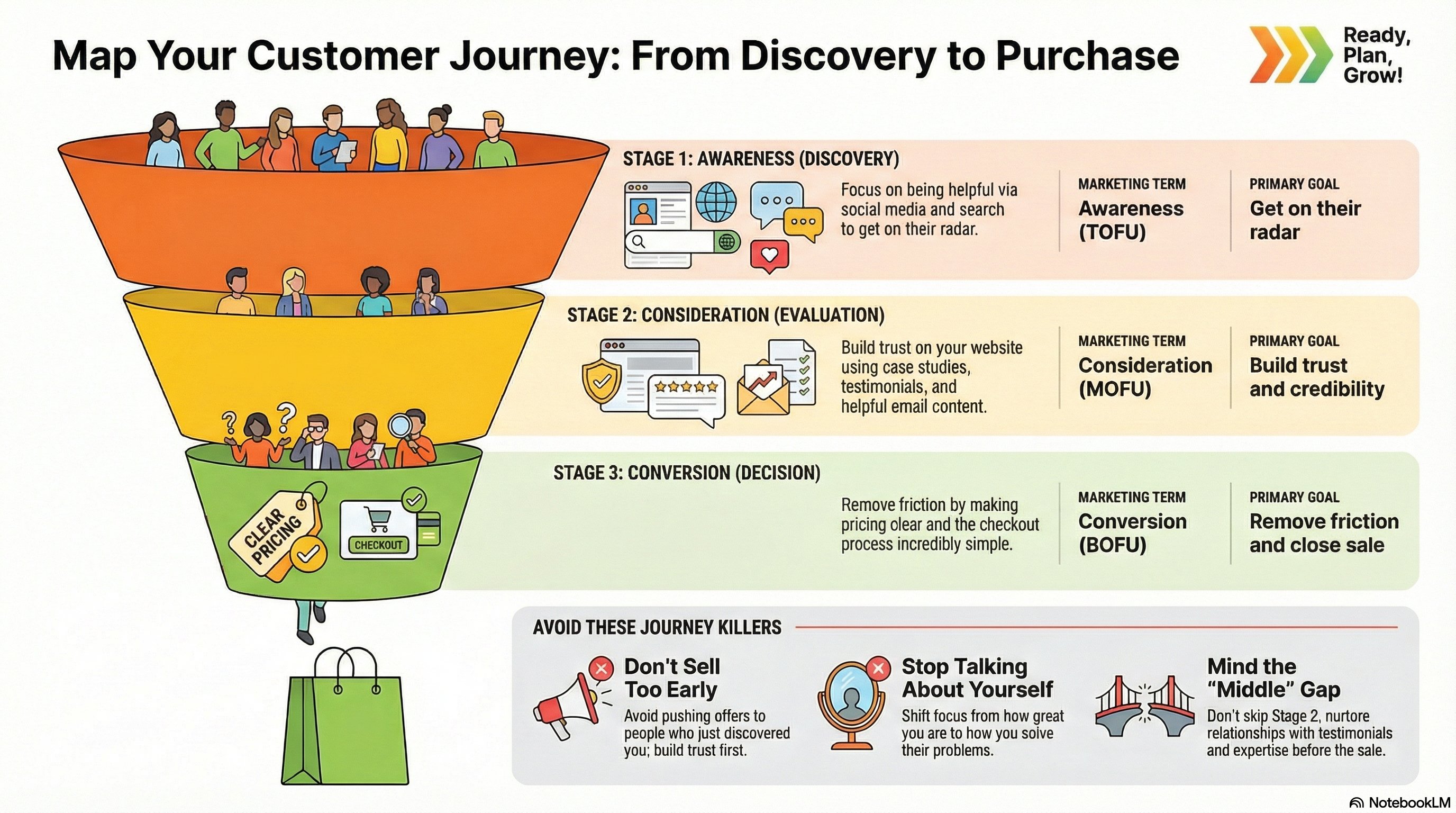
Marketing people call it a funnel because lots of people start at the top and fewer make it to the bottom.
We prefer calling it the customer journey because it's more human.
Every customer who buys from you moves through three stages.
They don't know you yet. They are searching Google. Scrolling social media. Hearing about you from a friend. Asking ChatGPT how to solve a problem. More and more, they're starting with AI search instead of a traditional search engine.
They're checking you out. They visit your website. Read reviews. Look at testimonials. Compare you to someone else. Search "[your business] vs [competitor]."
This is why comparison pages matter. Your customers are already comparing you. If you don't help them evaluate, they'll do it without you.
They're ready to buy. They look at pricing. Review your offer. Decide whether to book or purchase. Sometimes they even ask AI, "Is this worth it?"
That's the whole thing.
When you see these stages clearly, small business marketing stops feeling like a mystery. It turns into a checklist.
How to find the leaks in your funnel
Start with where you're spending money.
If someone just discovered you, they need helpful information.
Not a hard sell.
If someone is comparing you to a competitor, they need proof. Not another inspirational post.
If someone is ready to buy, they need a clear next step. Not more education.
Your website should support each of those stages. Testimonials, FAQs, and comparison pages help people in the middle.
Without them, you end up spending more on ads trying to force something that a better page would fix on its own.
Now look at where you're spending time.
If sales feel slow, the instinct is to create more content. But the real issue might be something simpler. No testimonials. No comparison page. Unclear pricing. No obvious next step.
If people are getting stuck while evaluating you, more discovery content won't fix that. Map the customer journey. Find where the friction actually is. Fix that first.
Then check how you're making decisions.
Without this kind of clarity, every marketing call feels emotional.
"Maybe I need ads."
"Maybe I need a rebrand."
"Maybe I need to post more."
When you understand the customer journey, you start asking better questions.
Are we showing up in search and AI search results?
Do we build trust once someone lands on our site?