Bring your questions to our free office hours. Grab a spot on the calendar.
Every list of AI words to avoid gets you part of the way. Delete "leverage" and "robust" and the writing still reads like a machine wrote it.
The words are the easy part. The structure, the invented statistics, and the confident tone with nothing behind it are what give the draft away.
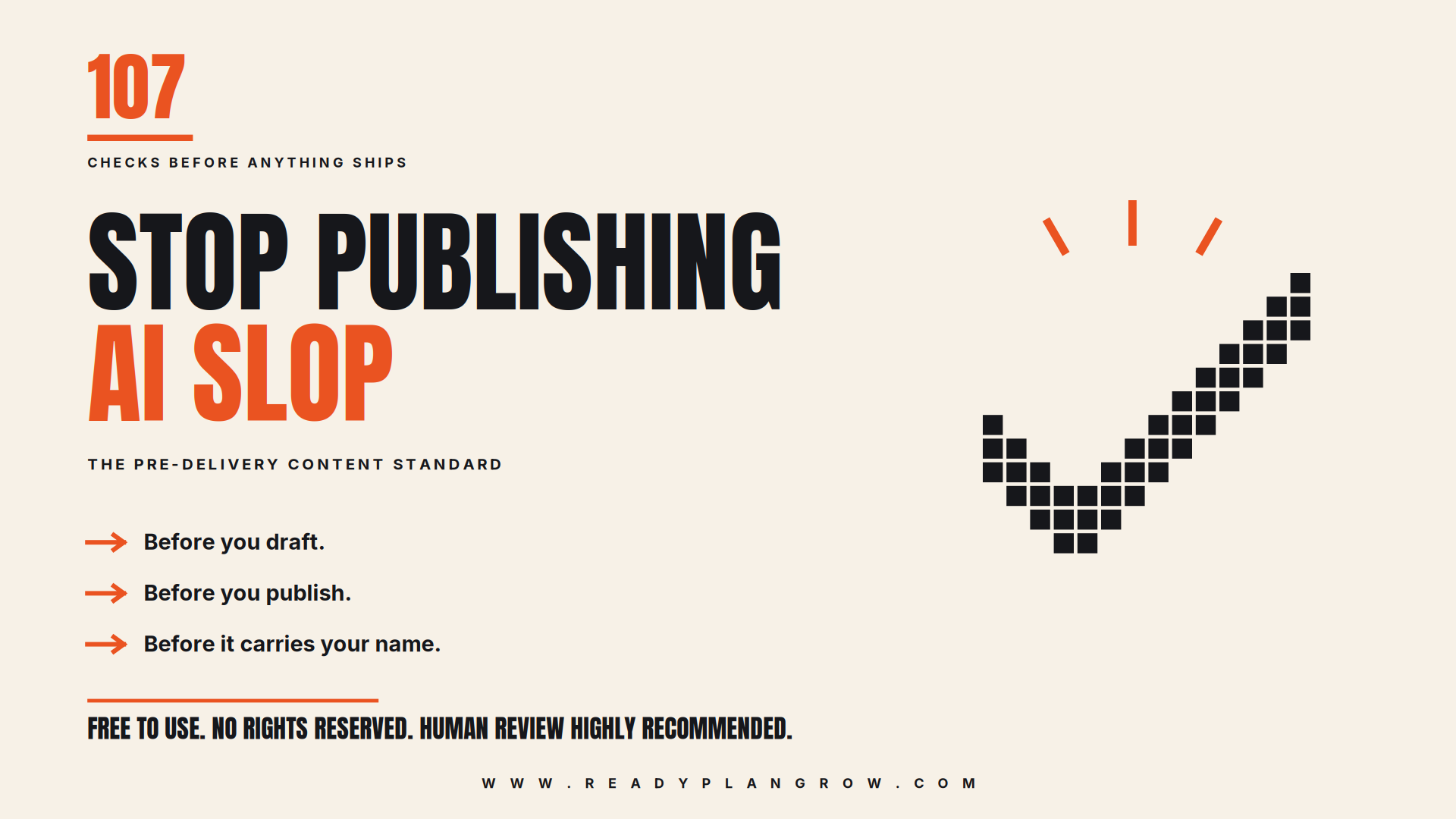
So we built the full check. 107 items, seven gates, written for a machine to follow. Paste it into your AI's instructions and it runs before anything reaches you.
What the standard checks
| Gate | What it checks |
|---|---|
| 0 | What has to exist before a word gets written. Keyword, title, source documents. Fails here and the piece doesn't get drafted |
| 1 | Punctuation, voice, vocabulary. Zero em dashes, filler words, and every AI word to avoid paired with what to use instead |
| 2 | Structure. How it opens, how it ends, sentence length, paragraph length, heading hierarchy |
| 3 | SEO. Metadata, character counts, links, and every URL fetched rather than written from memory |
| 4 | Sourcing. Every figure carries its year and links the page for that year. Nothing invented |
| 5 | File format and handoff |
| 6 | Six questions that need a person, not a script |
How we do things (and what we recommend you do)
Start with a knowledge base. That's the core documentation about your business that your AI should know.
We recommend at least:
- Top three business goals (a basic business plan)
- Brand guide, including brand voice and founder's voice
- Marketing and content strategy
- Keyword research
- Competitive analysis
- Content plan (we run a 90-day rolling plan)
We pack ours together and call it the Business Backpack. It uses the same foundation as The Clear Business Framework, so it carries to any AI we use.
Then:
- Our gates have numbers. Ask for results by number, not "reviewed"
- Ask twice. After the AI says the gates are run, ask how many it checked and which ones
- Expect it to fail. It fails more than we'd like
- Be the human in the loop. ;-)